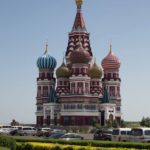
After the 1949 Communist revolution, Hulunbuir was annexed into Inner Mongolia, but the region kept economic ties to the rest of the northeast via the Chinese Eastern Railway.[4] During the Cultural Revolution, the parts of historical Manchuria inside Inner Mongolia were briefly restored to their original provinces; Hulunbuir was given back to Heilongjiang from 1969 to 1979.[4] Until October 10, 2001, Hulunbuir was administered as a League. The area is 263,953 km2 (101,913 sq mi) and had a population of 2.710 million in 2004, The jurisdiction area of the city is larger than all but 8 Chinese province-level divisions (and 42 U.S. states), although the actual urban agglomeration is just a very small part of the region, and the average population density of the area is very low.
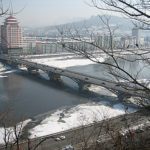
Tonghua 通化
Tonghua is an industrial city in the south of Jilin province, People’s Republic of China. It borders North Korea to the south and southeast, Baishan to the east, Jilin City to the north, Liaoyuan to the northwest, and Liaoning province to the west and southwest. it is a prefecture-level city with a total population of 2,325,242. It is known as one of the five medicine production centers in China.
Google Maps
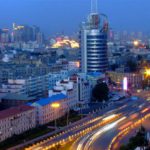
Siping 四平
Siping is a prefecture-level city in the west of Jilin province, People’s Republic of China. Located in the southwestern part of the province, in the middle of the Songliao Plain and at the intersection of Jilin, Liaoning and Inner Mongolia, Siping covers an area of 14,323 km2 (5,530 sq mi). At the 2010 census, Siping has a total population of 3,386,32.
Google Maps
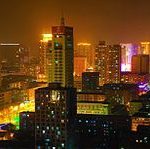
Mudanjiang 牡丹江
It was called Botankou under Japanese occupation. It serves as a regional transport hub with a railway junction and an international airport connecting with several major Chinese cities as well as Seoul of South Korea. Mudanjiang is located 248 km (154 mi) from Vladivostok, Russia.
Its population is 2,798,723 at the 2010 census whom 965,154 live in the built-up area made of 4 urban districts.[1] In 2007, the city is named China’s top ten livable cities by Chinese Cities Brand Value Report
Google Maps
- « Previous Page
- 1
- 2
- 3
- 4
- 5
- …
- 9
- Next Page »